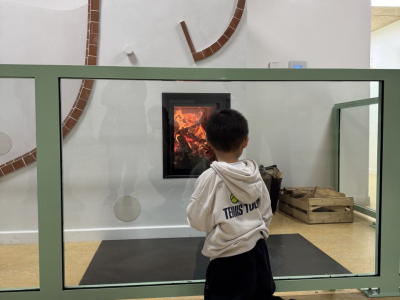


Unusual: A large brick heater with three fireboxes!
In Annonay, in the Ardèche, a single mass of firebricks combines three fireboxes: a main firebox with heated bench, a cast-iron cooker and a bread oven. A bypass means only one can be lit at a time.
On this blog, we follow self-builders who have built a made-to-measure masonry heater in their own home: how the build went, what technical choices it required. Today we show you how Cœur de Foyer can support you on your most ambitious projects.
A large heater made of small bricks
The build dates from 2018. It was carried out as a self-build. Thermasse produced the study, i.e. the design and the plans. Guiom, founder of Thermasse, supervised the work on site, and the owners built the heater with him.
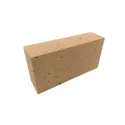
The heater stands in a large room with stone walls. It is built from small-format firebricks, laid one by one. A firebrick withstands the temperatures of a burning firebox without deteriorating. The small format has one advantage: it lends itself to curves. The seat of the bench thus follows a rounded line, marked out on the floor at the very start of the build.
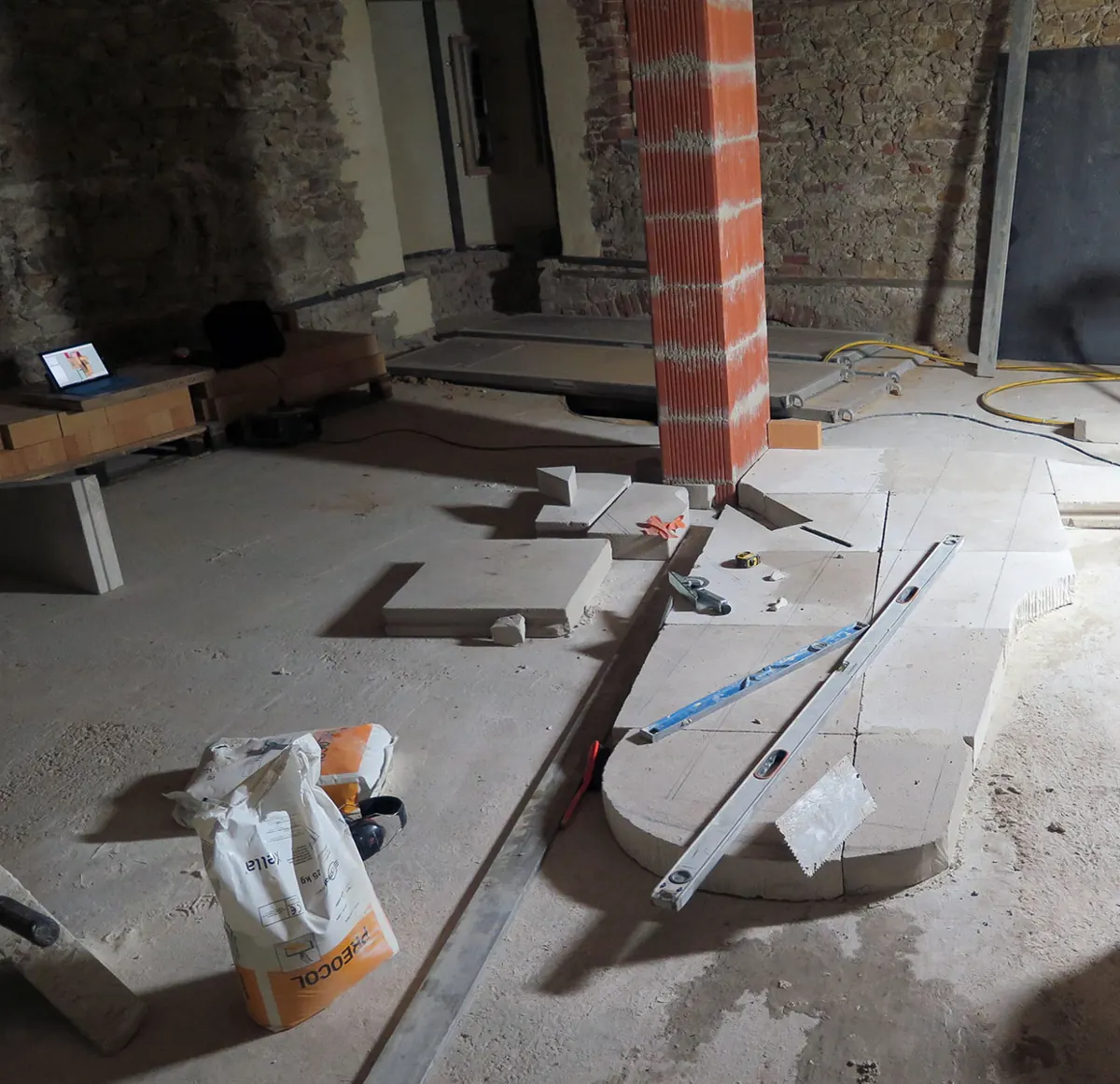
Building a large masonry heater with three fireboxes!
A masonry heater works by heat storage. A brisk fire charges a heavy masonry structure, the mass, with heat, which it then releases slowly by radiation. Here, the mass serves not one firebox but three. Each has its own function and its own flue circuit. These circuits were laid out at the study stage, before the first brick was laid.
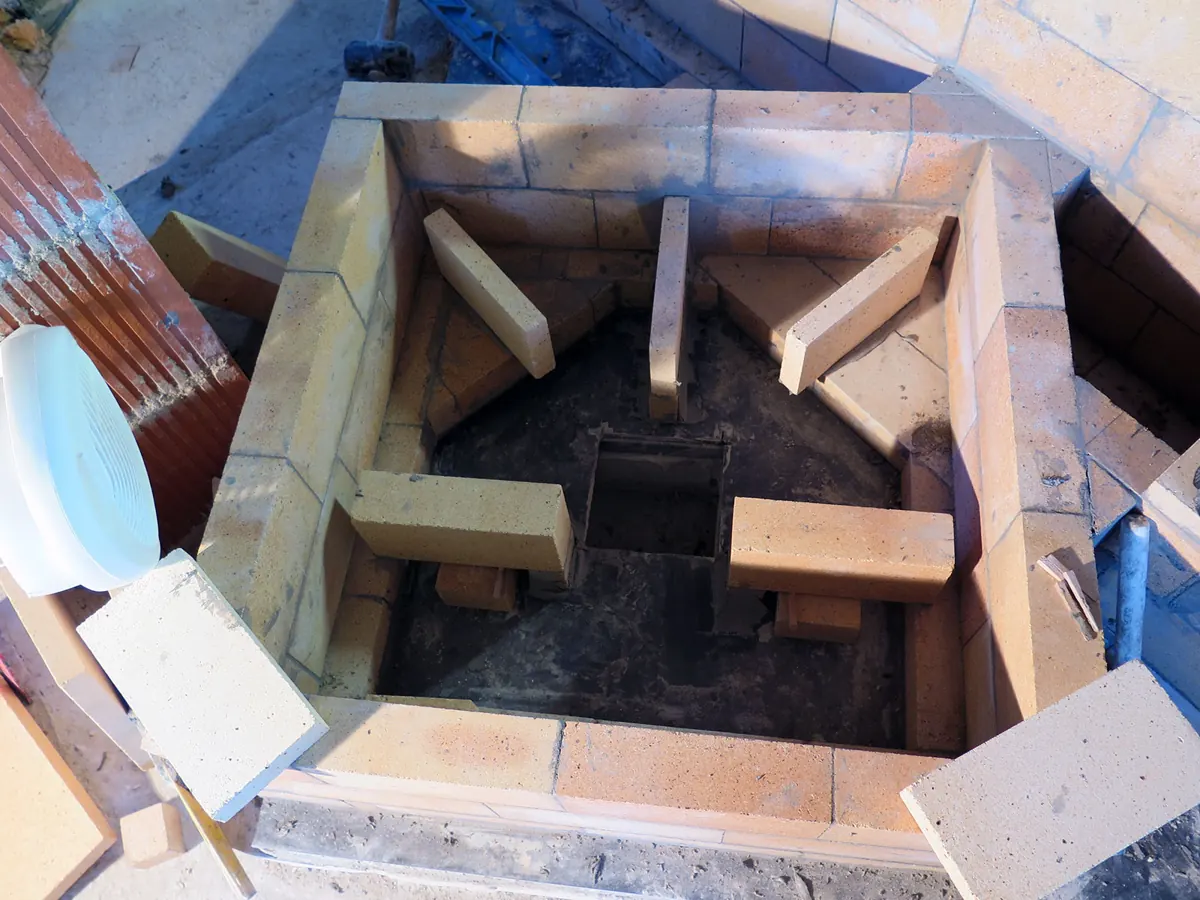
The main firebox
This is the heating firebox, closed by a glass door. It is extended by a heated bench: a masonry seat through which the flue gases circulate. The bench heats by contact and by radiation.
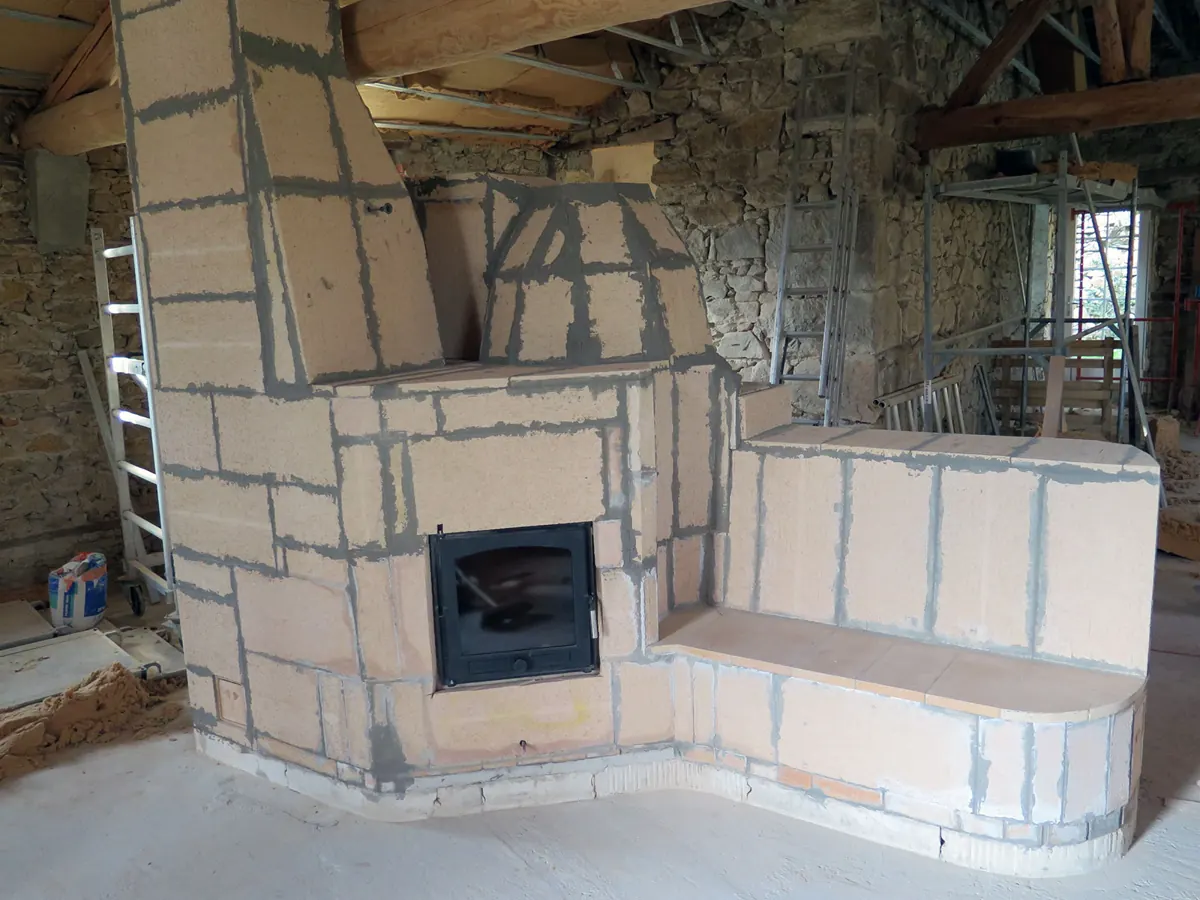
The masonry cooker
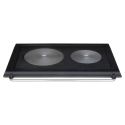
A cast-iron cooker, with its oven, is built into the mass. We speak of a masonry cooker when the cooking function is connected to the heat store, the part of the mass that stores the heat from the flue gases. The fire lit for cooking doesn't just heat the hotplate and the oven: its flue gases then pass into the mass, which retains their heat. Cooking and heating with the same wood is the whole point of this arrangement.
The bread oven
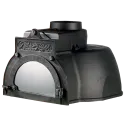
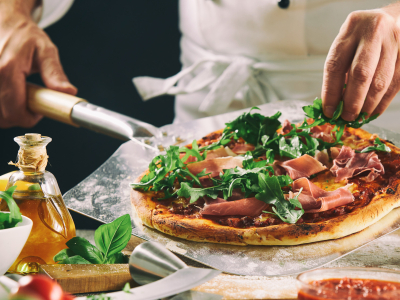
Above the cooker is a bread oven with an arched door. It works by direct firing: the wood burns in the cooking chamber itself. The oven therefore has its own fire, independent of the other two. Its flue circuit connects at the end of the heat store, just before the entry into the chimney flue.
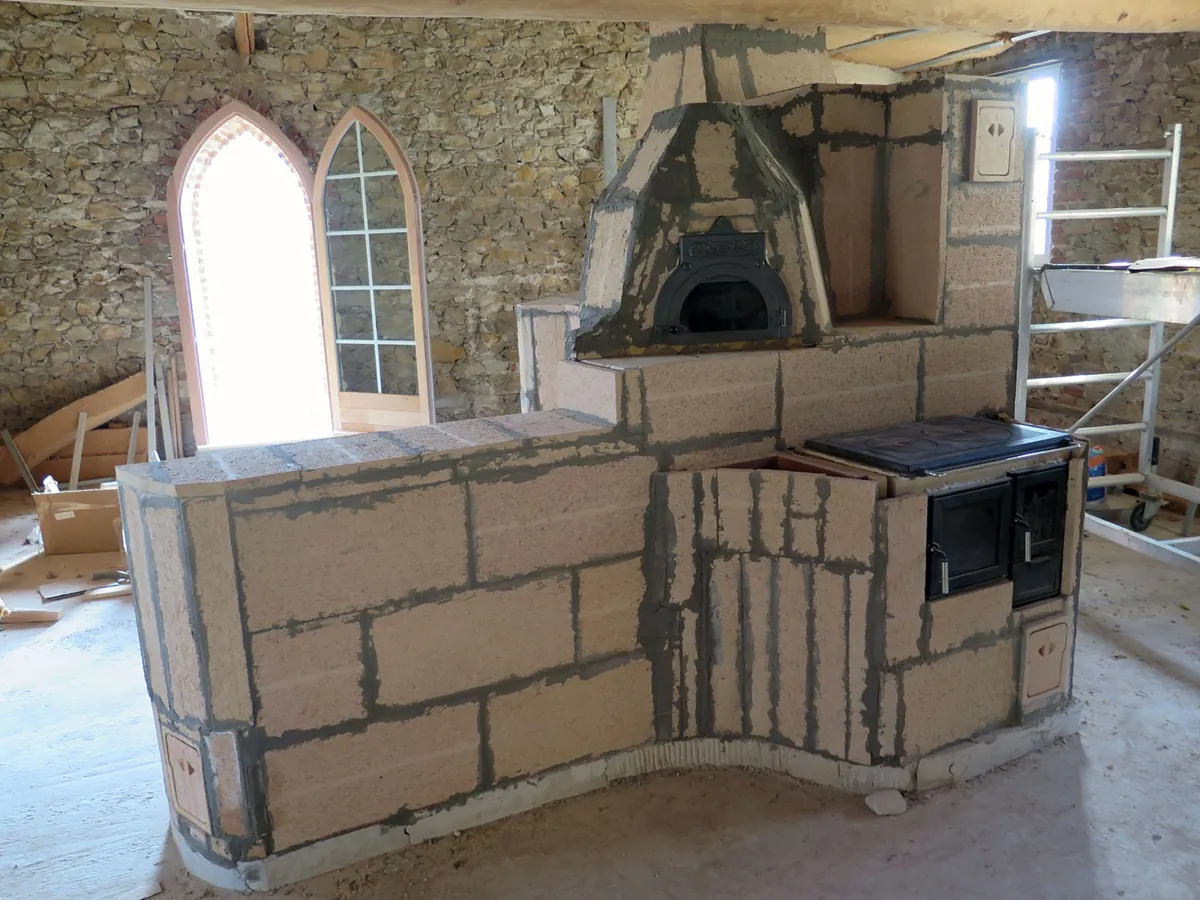
The masonry heater itself
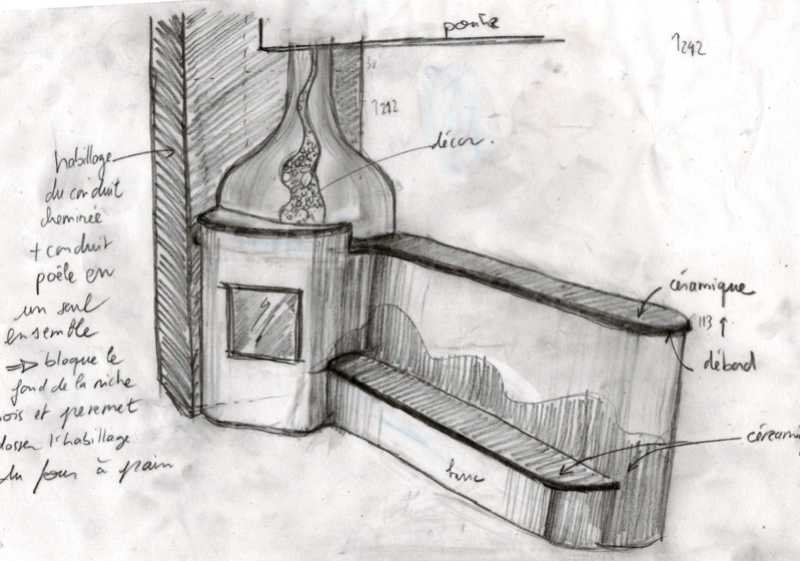
The flue gases follow this order:
- the flue gases from the main firebox first circulate through the seat of the heated bench;
- they are then directed to the backrest of the bench, which forms a bell-shaped heated wall;
- the cooker's circuit arrives in this same bell, at the bottom;
- the bread oven's circuit connects at the end of the heat store, just before the chimney flue.
A bell is a masonry chamber where the flue gases slow down. The hottest gases rise and collect at the top: they settle in layers by temperature, which is called stratification. On contact with the walls, they give up their heat, cool down and sink back towards the outlet. The heat stays in the masonry; the cooled gases leave towards the flue.
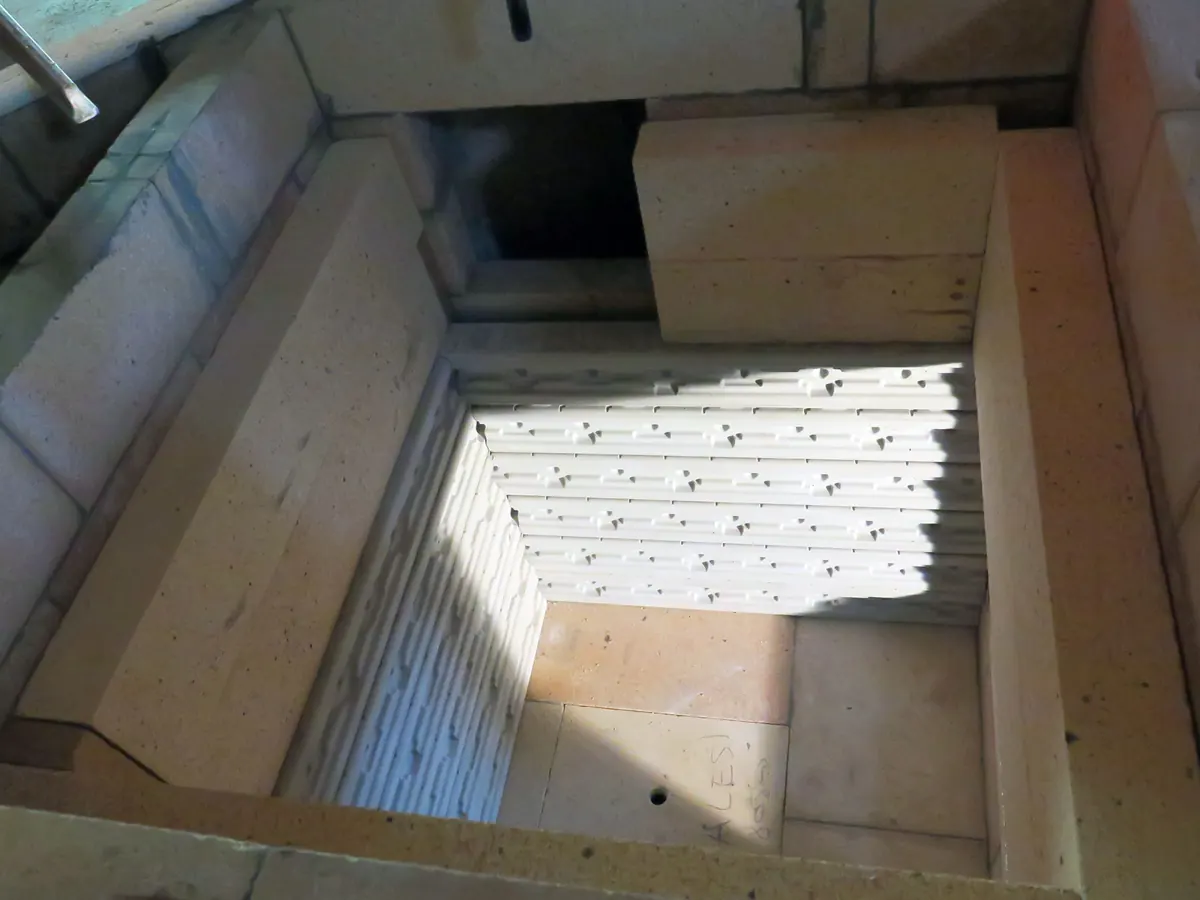
Why only one firebox at a time? All three circuits end at the chimney flue. Two fires lit together would compete for the draught, i.e. the suction that draws the flue gases towards the flue. The flue gases from one firebox could then spill back through another, into the room. The bypass removes this risk: it means only one firebox can be used at a time.
Conclusion
Three fireboxes in a single mass are not three heaters side by side. It is a single structure, whose flue circuits, connections and bypass are decided at the study stage. The Annonay build shows it: a project of this scale remains within reach of self-builders, provided it is designed in advance and supervised on site.
Key points
- A single mass of firebricks, three fireboxes: main firebox with heated bench, cast-iron cooker, direct-fired bread oven.
- The flue gases from the main firebox pass through the bench then a bell, which the cooker also joins; the bread oven connects at the end of the heat store.
- A bypass means only one firebox at a time, so that the flue gases from one firebox do not spill back through another.
- A self-build of this scale rests on a prior study and on-site supervision.
Sources: Thermasse project file (study, design sketches, site photos). Information checked on 04/10/2026.
Your project. Are you thinking of building a masonry heater yourself, with or without a cooker or bread oven? Cœur de Foyer supports self-builders: Thermasse study, plans, materials and site follow-up. Tell us about your project.
Share this content