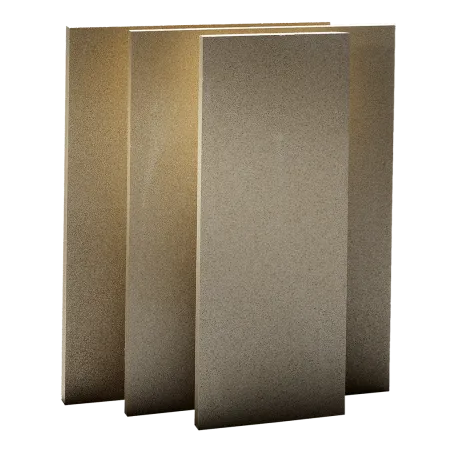
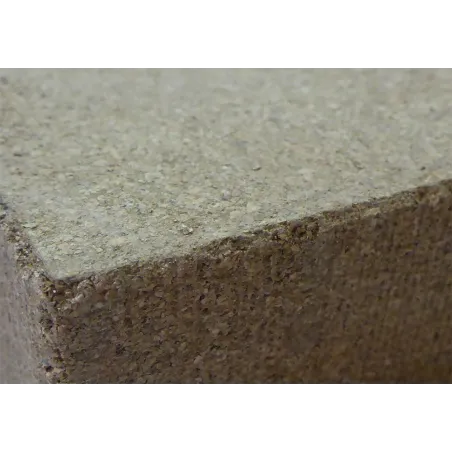
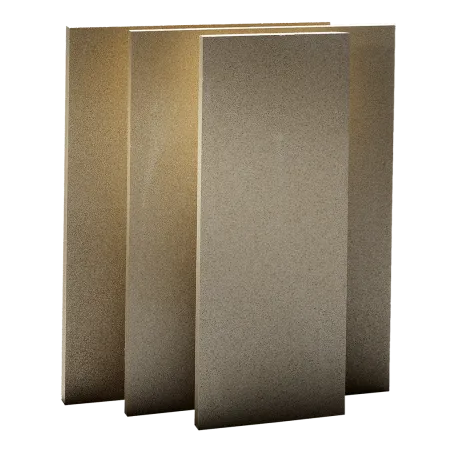
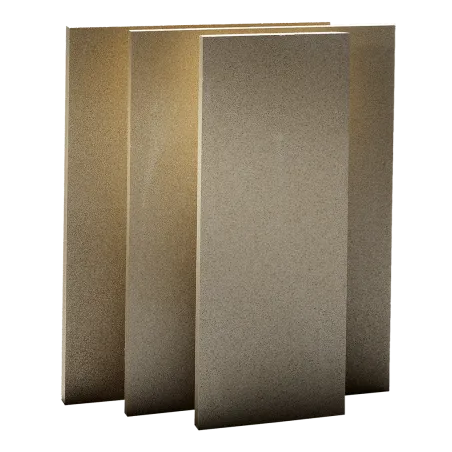
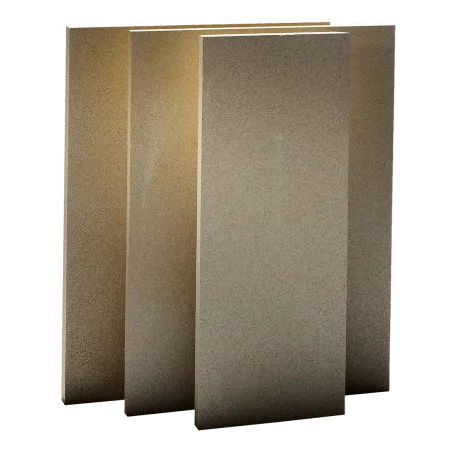
Vermiculite boards for stoves, inserts and fireplaces
30 mm Skamol vermiculite boards in three densities (600, 900 and 1,200 kg/m³), to line or replace the walls of a combustion chamber: wood-burning stove, insert, fireplace, masonry firebox. They withstand direct flame up to 1,100 °C, can be cut to size with a saw and come in two formats, 610 × 305 mm and 1,000 × 610 mm.
Values from the technical data sheets of the manufacturer Skamol (Denmark). Thermal conductivity is given at a mean temperature of 400 °C: the lower it is, the better the board insulates.
600 kg/m³: the lightest and most insulating. For the side and rear walls of a firebox, where the board takes no knocks.
900 kg/m³: the compromise. Stronger than the 600, it insulates almost as well and withstands up to 1,150 °C. The large 1,000 × 610 mm format lets you cut several pieces from a single board.
1,200 kg/m³ (VIP-12): more than twice as resistant to crushing as the 600. For the base, the lower walls and the areas where logs are placed and pushed. It insulates less: it is a protective board more than an insulator.
Vermiculite, grog or calcium silicate?
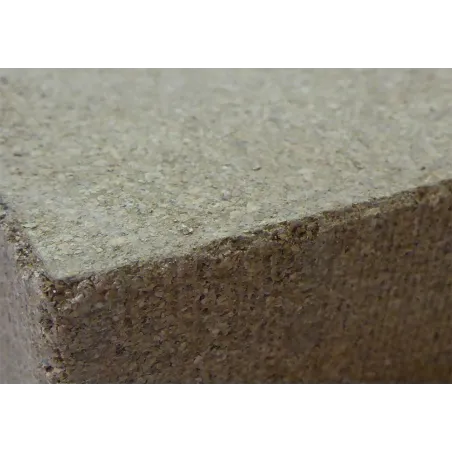
Vermiculite is an expanded mineral, light and insulating. It accepts direct flame and reflects heat back into the firebox, which helps combustion. It stores almost no heat.
Grog (refractory slabs and firebricks) is dense: from 1,900 to 2,250 kg/m³ depending on the product. It stores heat and releases it slowly; it is the material of the core of a masonry heater. It is also heavier and slower to heat up.
Calcium silicate (panels in the Boards & Panels category) insulates up to 1,000 °C but must not be in contact with flames: it is used to protect a wall, a casing or the back of a cladding.
To replace an original vermiculite board in a factory-made stove or insert, stay with vermiculite, at the original thickness.
Cutting and fitting
The boards are supplied in standard formats, without cutting to measure. They are easy to cut with woodworking tools: hand saw, jigsaw or circular saw.
Transfer the dimensions of the old board, or make a cardboard template, before cutting.
Do not split the board through its thickness: it weakens it.
Vermiculite does not like moisture: store the boards in a dry place and let a damp firebox dry out before the first fire.
Frequently asked questions about vermiculite boards
Can a vermiculite board be in direct contact with flames?
Yes. All four boards are made for the inside of a combustion chamber: 1,100 °C service temperature (1,150 °C for the 900). Calcium silicate, on the other hand, must not be exposed to flame.
What thickness should I use to replace an original board?
The same as the original. Our boards are 30 mm thick; for another thickness, use the reference from your stove manufacturer.
Do you cut to measure?
No. The boards are sold in 610 × 305 mm and 1,000 × 610 mm and are easy to cut with a saw (see "Cutting and fitting" above).
Vermiculite 600, 900 or 1200: which lasts longest?
The denser the board, the better it resists knocks from logs and wear: the VIP-12 (1,200 kg/m³), then the 900. The 600 insulates best but marks more easily.
Can vermiculite be used in a masonry heater?
Yes, as a complement: to insulate a specific point or to separate two materials that do not expand in the same way. The firebox and the heat-storage mass remain in grog, which stores the heat.
A question about your stove? Contact us with the make and model, or a photo of the board to be replaced.